
How to Read Food Labels in UK Supermarkets (For UPF Beginners)
One of the most time consuming parts of reducing ultra-processed food is the time spent deciphering labels on food. At first, every packet feels like an exam you are not at all prepared for. On top of this, food labels also contain various nutrition figures, sometimes health claims and the UK’s traffic light system.
So, what is actually on a food label?
- Ingredients list
- Allergens
- Nutrition table
- Traffic light system
- Claims/marketing
Sounds confusing? Don’t worry, you don’t need to become a nutrition scientist to understand all this information. Throughout this article we will take a look at each part of a food label and what to look out for. And much like any skill, over time this becomes easier and quicker.
Ingredients Are Listed By Weight
The most obvious place to start is the list of ingredients. These are always listed by weight, so the item appearing first in the list are the most used ingredients and those towards the end are used the least.
As an example, if you are buying a beef burger you’d expect the first ingredient in that list to be beef and the lesser used ingredients to be the seasonings.
On some products you’ll also see percentages of some ingredients. Sticking with a burger as an example, some may list Beef (98.5%), Sea Salt, Black Pepper as the ingredients whilst another might list Beef (48%), Beef Chuck (30%), Beef Brisket (17%), Tapioca Starch, Sea Salt, Black Pepper, Preservative (Sodium Metabisulphite), Tellicherry Black Pepper, Antioxidant (Extracts of Rosemary). In the first example, the sea salt and black pepper can only make up 1.5% of the total weight of the burger. In the second example because the meat content is only 78% which means 22% of this is made up of other ingredients – not all of them are markers of UPF but some are.
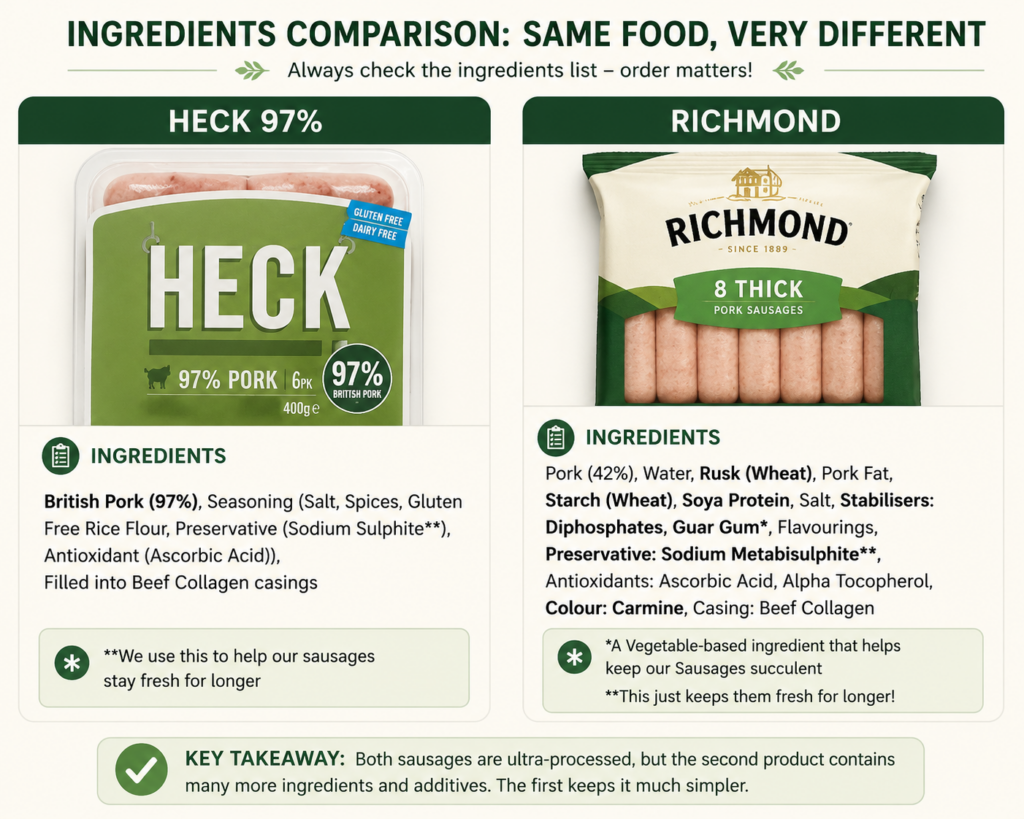
Why is this important? Let’s look at these two sausages.
Heck 97% ingredients: British Pork (97%), Seasoning (Salt, Spices, Gluten Free Rice Flour, Preservative (Sodium Sulphite**), Antioxidant (Ascorbic Acid)), Filled into Beef Collagen casings.
**We use this to help our sausages stay fresh for longer
Richmond Ingredients: Pork (42%), Water, Rusk (Wheat), Pork Fat, Starch (Wheat), Soya Protein, Salt, Stabilisers: Diphosphates, Guar Gum*, Flavourings, Preservative: Sodium Metabisulphite**, Antioxidants: Ascorbic Acid, Alpha Tocopherol, Colour: Carmine, Casing: Beef Collagen.
*A vegetable-based ingredient that helps keep our sausages succulent
**This just keeps them fresh for longer!
The first product contains 97% meat, which means the other ingredients listed make up just 3% of the total weight of the food. Sure, some of those ingredients are markers of a food being ultra processed, but compare it to the other sausages and 58% makes up the rest of the ingredients list. Are both ultra-processed? Sure. But are both equal? I would argue not, and one presents a better option.
Allergens
UK food labels must clearly highlight major allergens such as milk, eggs, wheat, soy, nuts and fish within the ingredients list, often in bold.
Even if you’re not managing allergies yourself, allergen information can help you quickly identify ingredients you may wish to avoid or compare between products.
Ingredients vs Additives
E300, E440, E500. E Numbers. Sounds scary eh? These E numbers are Vitamin C, Pectin and Baking Soda. Some E numbers are simple/common substances, while others are industrial additives more associated with ultra-processing.
Sodium Bicarbonate, Sodium Chloride and Acetic Acid. Baking Soda, Table Salt and the naturally occurring acid found in vinegar. Again, these are all totally normal ingredients that you can pick up in your local supermarket but sound chemical. But yet the words modified and flavourings are words that are totally normal to most.
It takes a bit of time to learn but the main things to look out for are flavourings, emulsifiers, sweeteners, colourings, modified starches and preservatives. The key thing is to not write food off just because the ingredients sound unfamiliar. There was a time where jackfruit was an unknown in this part of the world.
Some E numbers are more commonly found in ultra-processed foods, while others are simply familiar ingredients with technical names. Context matters more than the presence of an E number alone.
Quick Things to Notice
When scanning an ingredients list, look out for:
- Very long ingredient lists
- Multiple sweeteners
- Emulsifiers
- Flavour enhancers
- Modified starches
- Artificial colourings
- Ingredients you would never normally cook with at home
Remember: seeing one of these doesn’t automatically make a food “bad.” The goal is simply to build awareness and compare products within the same category.
Marketing Can Be Misleading
How often do you see phrases like “high protein”, “plant based”, “vitamin enriched” or “source of fibre” written on a package? Or perhaps “no artificial colours” or “no artificial flavours”?
All those things sound great, but what do they actually mean? The honest answer is not very much. Often they can even be used to give foods a “clean label” and conceal other details.
Phrases to do with being plant based, high in protein or fibre don’t actually give any details about ingredient lists or quality. Claims of “No Artificial colours” doesn’t mean no emulsifiers.
Another way to consider this is that when you pick up any fresh fruit or vegetables, they don’t have any health claims on the front of them and most foods that are good for you don’t need to advertise that fact.
Traffic Light System
Food sold in the UK has to display the traffic light system, the purpose of this is to give a very simple and quick visual on how the food rates on key nutrition details.
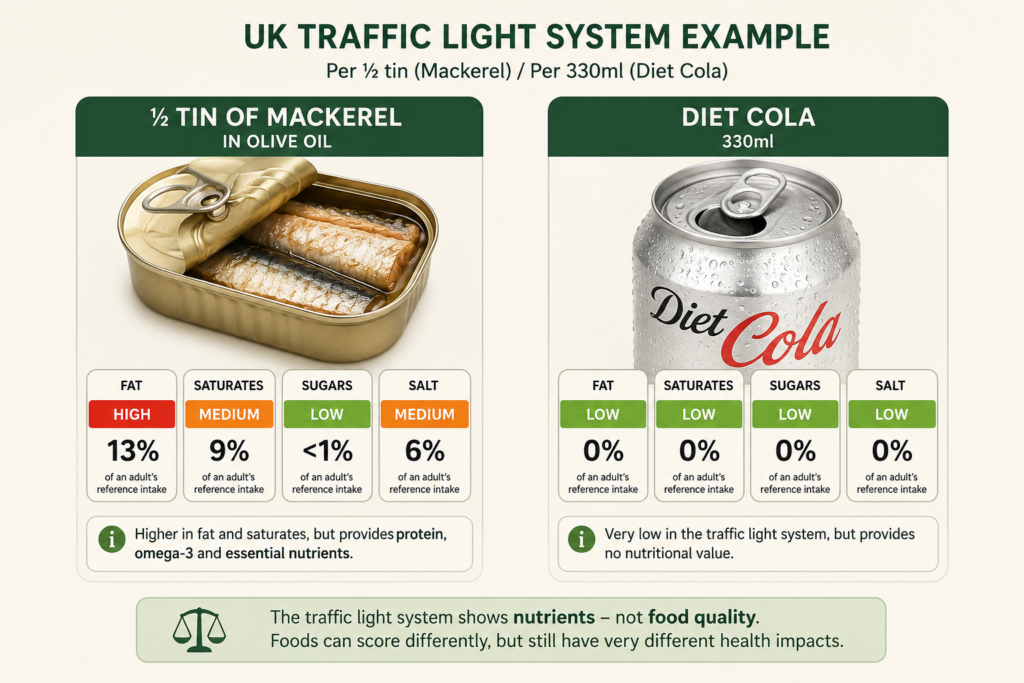
However, compare these two different products:
Half a tin of Mackerel in Olive Oil scores the following:
- Fat – Red – 13%
- Saturates – Orange – 9%
- Sugars – Green – <1%
- Salt – Orange – 6%
Whilst Diet Cola scores the following:
- Fat – Green – 0%
- Saturates – Green – 0%
- Sugars – Green – 0%
- Salt – Green – 0%
Taken at face value, these labels could lead someone to assume Diet Cola is the healthier choice whilst a tin of mackerel appears to have one high risk and two medium risks out of four subjects.
Unfortunately this is the downside of the traffic light system, and it doesn’t really provide an awful lot of nuance or context. It focuses purely on fats, sugar and salt and often the suggested serving size is unrealistic for the numbers given. It doesn’t take into account processing, additives or quality of ingredients.
Final Thoughts
One of the easiest things to do to help with this is to do as much of your shopping in the fresh produce sections as is practical for your needs. That reduces the number of labels you’ll be reading without any major effort!
The best advice is to not worry about everything and just focus on small gradual changes. If you only read the labels on your breakfast cereal at first and ignore everything else then you’ve made a start.
Another key thing to remember is that you do not need to analyse every ingredient forever. Reading labels is about awareness and slowly building confidence. Perfection is never the aim.
The goal isn’t to fear food or achieve perfection. It’s to become a more confident shopper who can make informed choices that work for you and your family.
Leave a Reply
You must be logged in to post a comment.