Beginner’s Guide to Reducing Ultra-Processed Food: 5 Simple Steps
So, you’ve decided you want to eat less ultra-processed food — but have absolutely no idea where to start?
Maybe you’ve thought some of the following things:
- “I know UPF is bad, but what do I eat instead?”
- “Healthy food is expensive.”
- “I don’t have time to cook from scratch.”
- “My kids only eat packaged food.”
- “Food labels are too complicated.”
If so, don’t worry — you are definitely not alone.
There is a huge amount of information online about ultra-processed food (UPF), and a lot of it can feel overwhelming, contradictory, or overly technical. Rather than bombarding you with scientific jargon or expecting you to change your entire lifestyle overnight, this guide breaks things down into 5 simple, realistic steps.
The goal here is not perfection. It’s progress.
What Is Ultra-Processed Food (UPF)?
Ultra-processed foods (UPFs) are industrially manufactured foods that often contain additives, flavourings, emulsifiers, preservatives, sweeteners, or ingredients you would not typically use in a home kitchen. That does not automatically mean every UPF is “poison” or that every minimally processed food is perfect. The reality is far more nuanced than that. The aim of reducing UPF is usually to:
- eat more real, minimally processed food,
- rely less on heavily formulated convenience foods,
- and improve overall diet quality over time.
If you want a deeper explanation, check out:
Understanding UPF Through the Tortilla Chip Example
1 – Set a Realistic Goal
Your goal does not need to be rigid, perfect, or permanent. In fact, your approach will probably evolve the more you learn about food and processing.
Some people aim to:
- reduce UPFs to a small percentage of their diet,
- cook more meals from scratch,
- or simply become more aware of what they are eating,
- others may eventually decide they want to avoid most UPFs altogether.
There is no universally “correct” answer. At the beginning, even researching UPF and becoming more mindful of your food choices is already a positive step.
The key is to choose an approach that feels:
- realistic,
- sustainable,
- and manageable for your lifestyle.
2 – Familiarise Yourself With NOVA
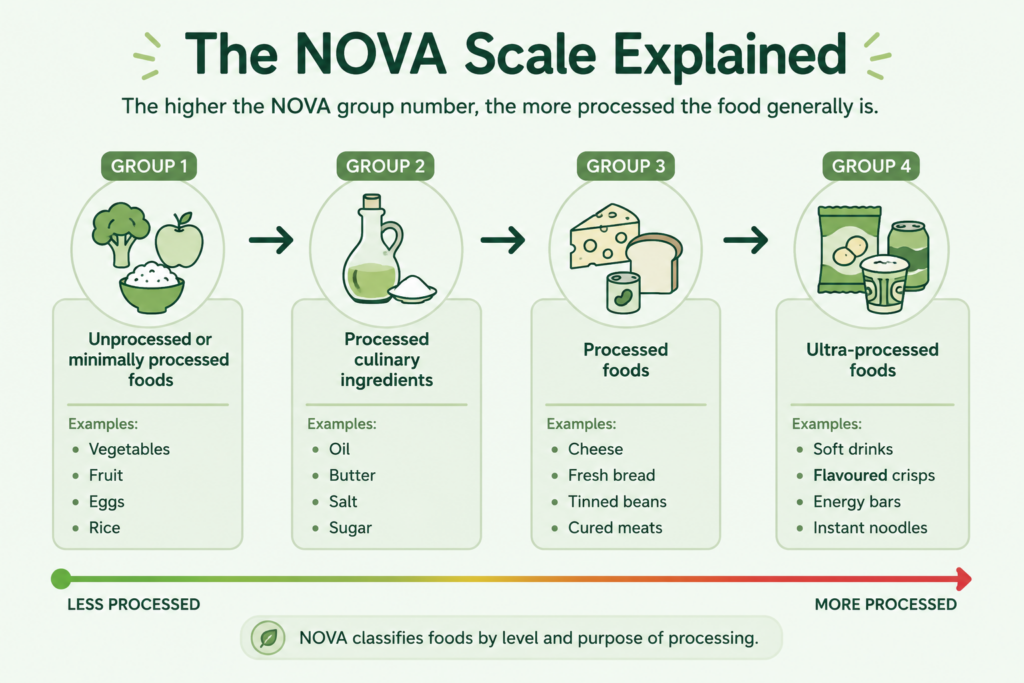
If you spend more than about 10 minutes reading about UPF online, you will eventually come across the NOVA classification system.. It divides foods into four categories based on the extent and purpose of processing.
The four NOVA groups are:
- Group 1: Unprocessed or minimally processed foods
- Group 2: Processed culinary ingredients
- Group 3: Processed foods
- Group 4: Ultra-processed foods
One important thing to understand is that processing itself is not automatically bad.
For example freezing vegetables, baking bread, making cheese or cooking beans are all forms of processing. The concern around UPFs is generally focused on foods that are heavily industrially formulated for convenience, shelf life, taste, texture, and overconsumption.
For a more detailed breakdown of the NOVA system:
What Is The Nova Food Classification System?
3 – Read Ingredient Lists (Without Overthinking Them)
Right, so now you’ve set a goal, vaguely understand NOVA, and marched into the supermarket full of motivation.
Unfortunately, food manufacturers do not exactly make this easy. Many products are marketed as “healthy” despite being highly processed. There are plenty of free food-scanning apps available that can help simplify things, but learning to read ingredient labels yourself is still a really useful skill.
A good starting point is to ask questions like:
- Does this look like real food?
- Would these ingredients normally exist in a home kitchen?
A long ingredient list does not automatically make something unhealthy or ultra-processed, and a short ingredient list does not automatically make something healthy. The goal is not to become afraid of ingredients. It is simply to become more aware and informed over time. As you learn more, you will naturally start spotting patterns.
4 – Take Baby Steps
This is probably the most important part of the entire process. Although reducing UPF is not really a “diet,” it follows the same basic rule as most lifestyle changes: If you try to change everything overnight, you are far more likely to give up completely.. Long-term success usually comes from slow, deliberate, sustainable changes.
For example:
- switch your breakfast first,
- find a new lunch option for work,
- cook one extra homemade dinner each week,
- or replace one regular snack with something less processed.
Do not try to completely reinvent breakfast, lunch, dinner and your family’s eating habits all at once. Change what feels easiest first, then build from there. Small habits repeated consistently are far more powerful than extreme short-term changes.
5 – Keep Learning and Stay Curious
This is the point where most people start falling down internet rabbit holes. There is loads of information, loads of opinions and unfortunately loads of nonsense as well. The whole reason this website exists is so you do not have to spend hours trying to work everything out yourself. I’ll be sharing:
- shopping guides,
- recipes,
- supermarket swaps,
- ingredient breakdowns,
- beginner-friendly articles,
- and practical tips to help make reducing UPF simpler and less overwhelming.
The goal is not fearmongering or perfectionism — it is helping people make more informed choices in a realistic and sustainable way. So feel free to bookmark this website, explore the Resources section, join our email list and follow along on social media.
And if you have questions, suggestions, or want help finding better alternatives to your favourite foods, get in touch. Even if your only goal right now is finding “the least ultra-processed chicken nugget money can buy”!
Final Thoughts
You do not need to completely change your diet overnight to make meaningful improvements to your health. Reducing UPF is not about perfection. It is not about guilt. And it is definitely not about never eating another packet of crisps again. It is simply about becoming more aware of what you eat and gradually building habits that work for you.
Because realistically, the best diet is probably not the one that is “perfect.” It is the one you can actually stick to.
Leave a Reply
You must be logged in to post a comment.