
Processed vs Ultra-Processed Food: What’s the Difference?
One of the biggest misconceptions in conversations around ultra-processed food (UPF) is the idea that food processing itself is bad — especially when a lot of it happens in factories using industrial machines. Certainly the image of gigantic industrial equipment churning out food onto a conveyor belt is not one that immediately makes you think of a nutritious meal. But does that automatically make it unhealthy?
First we have to understand what processed food actually is and what ultra-processed food is.
In reality, almost all food is processed in some way. Cooking, freezing, drying and grinding are all forms of processing. It is not just the act of processing that is important, but the intention behind it. Understanding the how, the why and the purpose are the key to understanding the difference between processed food and ultra-processed food.
What Is Food Processing?
The word “processing” does not exactly make food sound appealing. But think of the bag of peas sitting in your freezer. They have been shelled, washed and frozen. All of those are processes. In the most simplistic sense, processing simply means altering food from its original state — and it is something humans have been doing for thousands of years. Baking, fermenting, drying and smoking are all centuries-old processing techniques. Other times processing exists simply to make food safe, improve convenience or preserve it for longer.
Again, think back to that bag of peas. Shelling them improves convenience and freezing them helps preserve them. These processes are useful for improving food safety, reducing waste and making food more practical to store and eat. There is even some nutritional research suggesting certain foods can sometimes retain nutrients better when frozen or canned compared to sitting fresh for extended periods.
As we can see, processing itself is not automatically unhealthy. One of the things that confuses people is that because those peas are shelled by a large industrial machine rather than by hand, the process somehow appears more sinister — despite the end result being exactly the same.
What Is Ultra-Processing?
Ultra-processing is different. In some ways, the term “ultra-processed” is slightly unfortunate because people often focus too heavily on the word “processed” rather than what makes the food different in the first place. Ultra-processed foods are usually industrial formulations made using refined ingredients and additives such as flavourings, emulsifiers, sweeteners, preservatives and colourings. They also often involve manufacturing techniques designed to alter texture, flavour, shelf life and mouthfeel.
UPFs are often highly palatable, heavily marketed, convenient and easy to overconsume. That is one reason discussions around UPF are often less about machines themselves and more about formulation, engineering and the purpose behind the product. This is the distinction the NOVA system tries to identify, which is why you will often hear foods described as NOVA 1, 2, 3 or 4.
And as with almost every discussion around UPF, there is still nuance involved. A food being convenient does not automatically make it unhealthy. A scientific-sounding ingredient does not automatically make it dangerous. And not every packaged food is ultra-processed. Context matters.
Emulsifiers vs Emulsified
If the distinction is that simple, then why are we discussing all these changes? Because it is not just about identifying obvious additives. The broader context matters too.
Preserving food itself is not inherently bad — humans have been preserving foods using salt, fermentation, smoking and drying for centuries. But not all preservatives are created equal.
The same applies to emulsification.
Imagine you are making a traditional Italian carbonara. You have guanciale and the rendered fat in a pan, you add your cooked pasta, eggs and pecorino mixed together and then a splash of starchy pasta water added at the end. As those ingredients combine together, the fat, water, cheese and egg blend into a smooth sauce. The sauce has become emulsified. That emulsification happened naturally through ingredients, technique and cooking methods. In many ultra-processed foods, that same effect is instead created using industrial emulsifiers added specifically to alter texture, stability, consistency and shelf life.
That is an important distinction to bear in mind. It highlights one of the key lessons around UPF: it is rarely just one ingredient or one process alone that matters but a combination of factors.
Examples of Processed vs Ultra-Processed Foods
So how do we actually tell the difference?
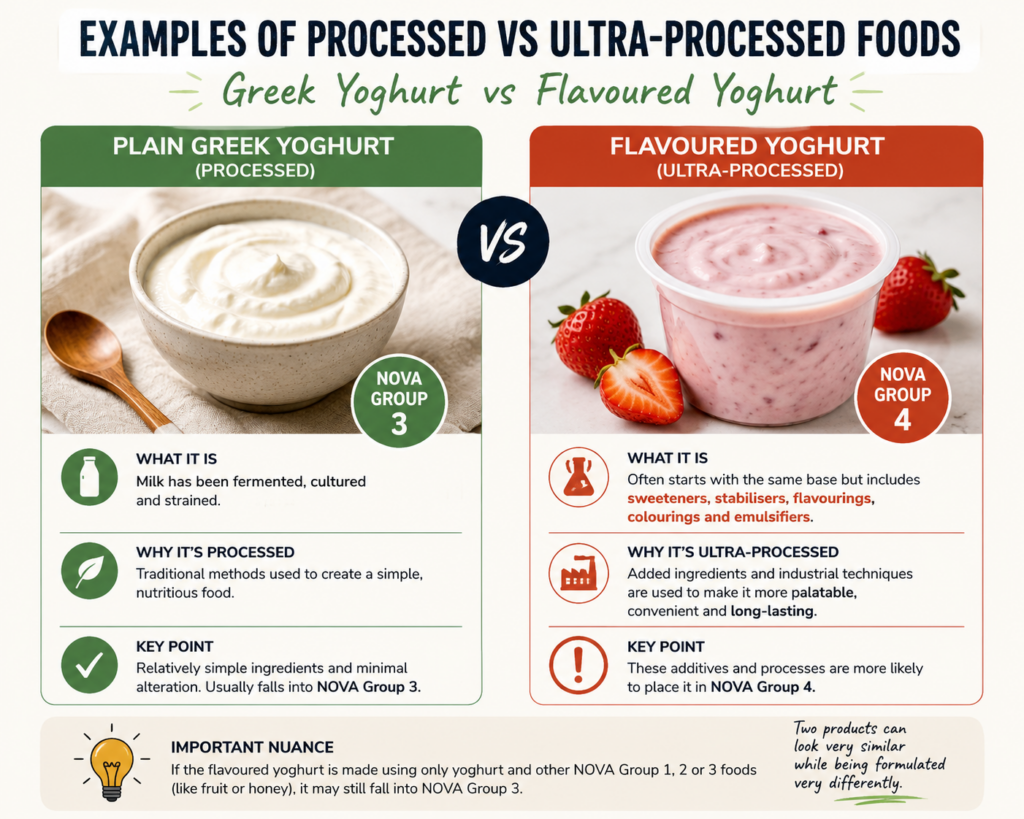
Greek yoghurt is a good place to start. Plain Greek yoghurt is processed food. Milk has been fermented, cultured and strained, but it is still a relatively simple food made using traditional methods and usually falls into NOVA Group 3. Many flavoured yoghurts start with the exact same base product but then add sweeteners, stabilisers, flavourings, colourings and emulsifiers. Those products are far more likely to fall into NOVA Group 4.
However, not all flavoured yoghurt is automatically ultra-processed either. If a yoghurt simply contains yoghurt, fruit and perhaps honey, it may still remain in NOVA Group 3. Two products can look almost identical while being formulated very differently underneath.
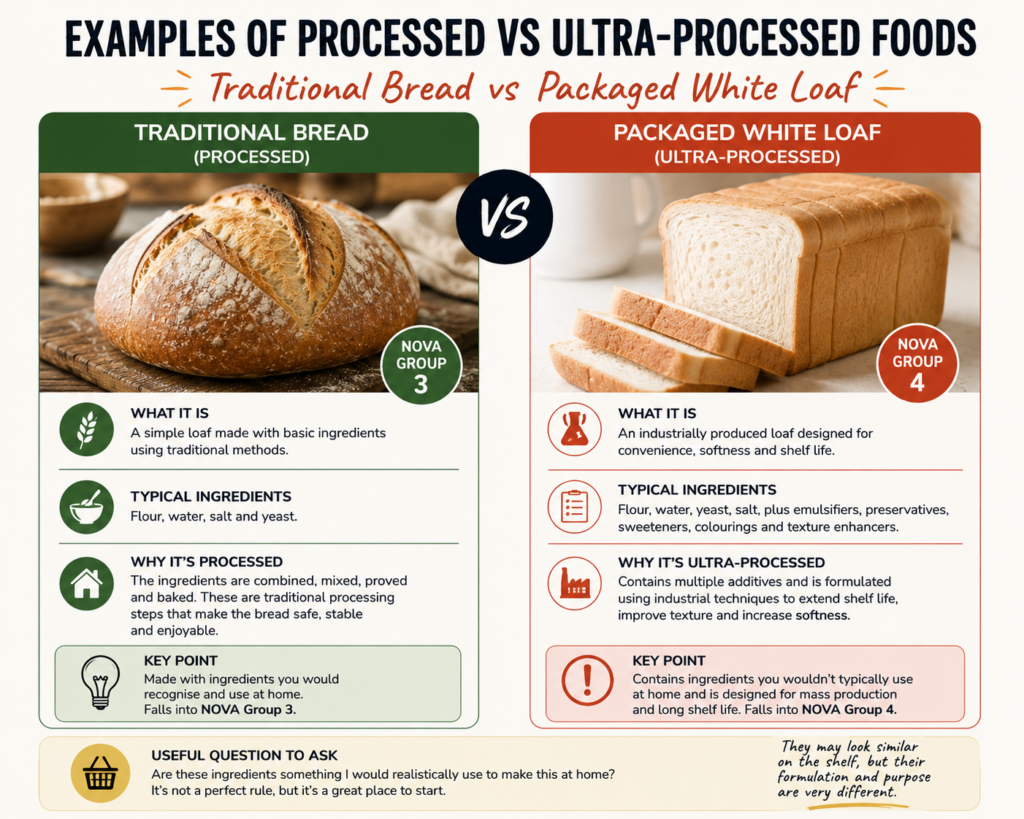
Bread is another excellent example. A traditional loaf may contain little more than flour, water, salt and yeast. That is very different from some industrial packaged breads containing emulsifiers, preservatives, sweeteners, colourings and texture enhancers. Again, one may fall into NOVA Group 3 while the other sits in Group 4.
One useful question to ask is:
Are these ingredients I would realistically use to make this at home?
That is not a perfect rule, but it is often a useful starting point.
Tortilla chips are another great example of nuance. Some are made using little more than corn, oil and salt. Others contain flavour enhancers, additives, acidity regulators, colourings and industrial flavour systems. They look almost identical sitting on a supermarket shelf but may belong to completely different NOVA groups.
Check out this article for a deeper breakdown:
Understanding UPF Through the Tortilla Chip Example
Why Ultra-Processed Foods Are Different
It is not just scientific-sounding ingredients or the number of processes that make a food ultra-processed. There is not really a perfect formula for identifying UPF. The distinction is usually more about how heavily altered the original ingredients have become, how the food has been formulated and why it was created in the first place. And very often, the answer to those questions leads back to convenience, repeated consumption, shelf life, hyper-palatability and profit.
But again, nuance matters.
Most sliced brown bread in UK supermarkets would likely fall into NOVA Group 4 — yet many are still high in fibre. Most baked beans would also fall into NOVA Group 4 — yet they are still cheap, filling, accessible and nutritionally useful foods.
It would be disingenuous to suggest foods like these should automatically be avoided entirely when, as part of a balanced diet, they can still offer benefits.
Processing Is Not the Enemy
This is probably the single most important point in the article. Processing itself is not bad. In fact, it would be almost impossible to remove processed food from your life entirely. Freezing, cooking, pasteurising, grinding, fermenting, drying and baking are all forms of processing. The word “processed” does not need to be feared. What the NOVA system attempts to identify is the degree and purpose of processing.
Generally speaking, foods in Group 1 are closer to their original source, Group 2 slightly further away, Group 3 more altered and Group 4 the most heavily formulated. From a dietary point of view, it is probably sensible to eat more foods from Groups 1–3 and rely slightly less on Group 4 foods overall. But all four groups can still exist within a balanced diet.
Final Thoughts
Learning the difference between processing and ultra-processing can completely change how you think about food. It moves the conversation away from fear and rigid food rules towards context, understanding and informed decision-making.
The reality is that food is rarely black and white. Not every packaged food is ultra-processed. Not every minimally processed food is automatically nutritious. And two foods that look almost identical can sometimes belong to completely different NOVA groups. The goal is simply understanding food well enough to make choices that work for your health, your lifestyle and your priorities.
Leave a Reply
You must be logged in to post a comment.