
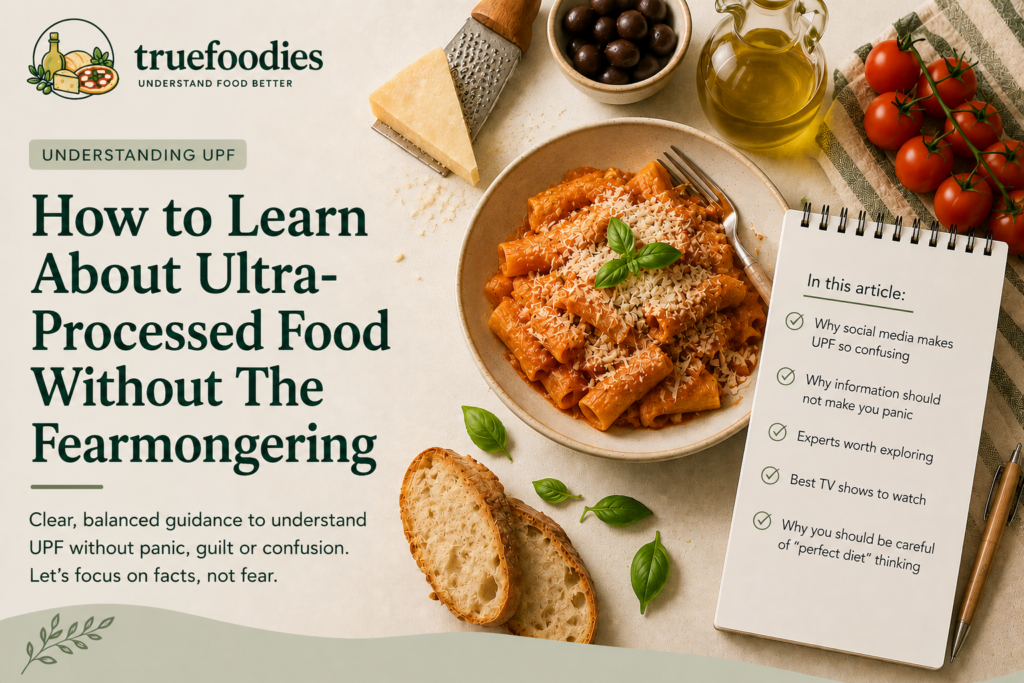
How to Learn About Ultra-Processed Food Without The Fearmongering
Whilst it may seem like a fairly simple concept, learning about UPFs is often a confusing minefield full of conflicting advice, strong opinions and broader health and nutrition debates. You may hear things like seed oils are toxic, additives are dangerous, and calls to throw half your kitchen away. You’re also equally as likely to hear that concerns around UPFs are fearmongering, companies wouldn’t be allowed to use additives if they were dangerous, and that all that really matters is calore control.
As with most things online these days, it is important to consider exactly where the information you are getting comes from. Why is this important? Because reducing UPF should be something you’re doing whilst feeling informed and aware of how modern food is produced. It shouldn’t leave you worrying whether you’re “allowed” to eat certain foods or feeling guilt over every choice you make.
Why Social Media Makes UPF So Confusing
Social media rewards strong opinions, controversy, certainty and emotional reactions. Nuanced discussions rarely go viral.
A video saying:
“THIS INGREDIENT IS DESTROYING YOUR GUT”will almost always perform better than:
“some ultra-processed foods may be worth reducing depending on your overall diet.”The issue is that most people understandably want quick answers, simple rules and certainty. But unfortunately, UPF is not a subject that can really be oversimplified. When you actually break it down, the topic involves nutrition, psychology, food systems, food science, digestion and behaviour. That is a very complicated list of things to squeeze into a 30-second video.
Of course, that does not mean every content creator talking about UPF should instantly be distrusted. There are some fantastic creators online sharing recipes, shopping ideas, educational content and genuinely useful discussions around food and diet.
Some of my favourites are listed on the Resources page.
The important thing is understanding the difference between evidence based educations and fear driven content. Look out for people who explain both sides of an argument, acknowledge nuance, avoid speaking in absolutes and encourage behaviour that is practical and realistic. Try to avoid creators who talk in extremes, presents opinions as unquestionable facts, or make every discussion sound like an emergency.
And it is always worth remembering:
Not all influencers are experts.
Information Should Not Make You Panic
This touches further on some of the extreme language often used around UPF online. Words like “toxic”, “poison” and “nasties” are everywhere on social media. Sometimes these phrases are used to highlight genuine concerns around heavily formulated foods, but they can also leave people feeling guilty, anxious or overwhelmed. This is one of the most important things to remember when learning about UPF, you are learning information to help you better understand your diet — not to live in fear of food.
Some creators go viral by making extreme statements. It is always worth taking a step back and asking whether the content is actually helping you or simply making you more anxious. Good information should help you feel calmer, more informed and more capable of making your own decisions. It should not leave you terrified of every ingredient label.
Learn From Long-Form Content, Not Just Clips
How do you make a 30-second clip go viral? Usually through dramatic headlines, oversimplified soundbites and strong emotional reactions. None of those things are particularly good for proper education. UPF is a subject that relies heavily on nuance, context, uncertainty and discussion.
That is why books, podcasts, documentaries, articles and long-form interviews are often far more useful than endless scrolling. Long-form content gives people space to explain uncertainty, discuss different viewpoints, and properly break down complicated ideas. That is usually where the real understanding comes from.
Experts Worth Exploring
So who should you follow? Well, as you will probably expect by now, there is no single perfect answer to that question. Different experts focus on different things, just as a nutritionist and a dentist may both suggest avoiding sugary drinks — but for completely different reasons.
The best approach is not to blindly follow one person, but to explore a range of perspectives and make your own informed decisions.
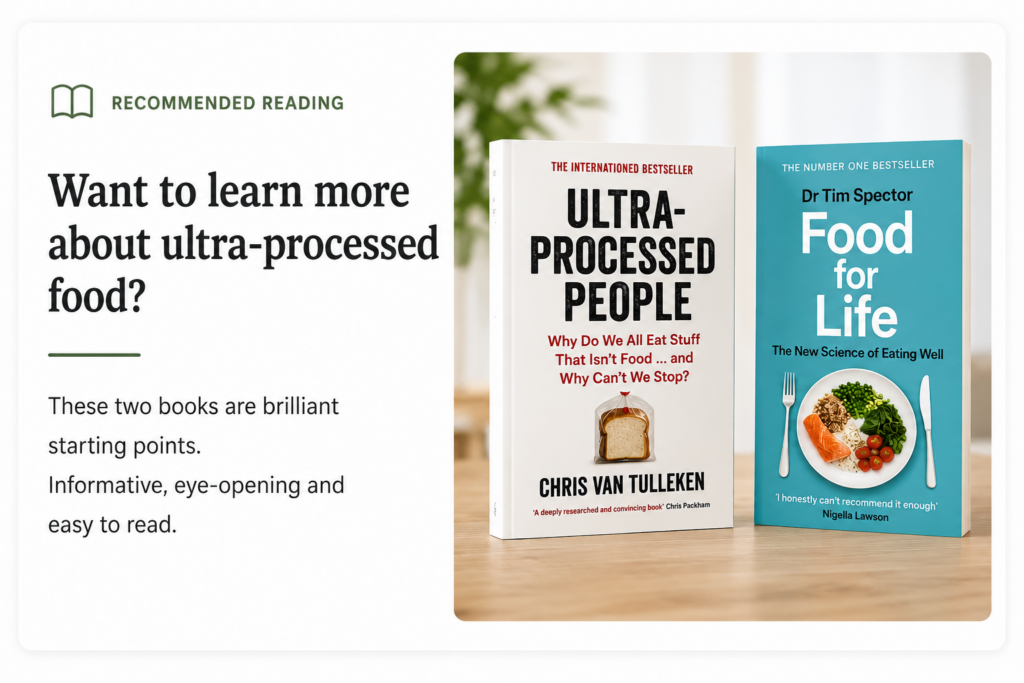
Check out the Resources section of the website for more recommendations on:
- books,
- podcasts,
- documentaries,
- and useful creators to follow.
Watch What Experts Actually Do
Reading not really your thing? There are plenty of documentaries, television shows, interviews and cooking channels worth watching instead. In fact, many home-cooked meals naturally end up being minimally processed without requiring obsessive analysis of every label. This type of content is useful because it turns words and ideas into practical and real life food!
Be Careful of “Perfect Diet” Thinking
As much as this website — and many of the resources linked throughout it — are built around the idea that diets high in ultra-processed food may negatively affect health, it is important not to take that idea to unhealthy extremes. We can very easily risk becoming obsessive about UPFs to the point where eating starts to feel stressful, ingredients become suspicious, going out for food feels impossible and food starts to cosume too much of our energy.
That is not the goal. Learning about UPFs is important, but it should help us better understand food — not force us to live in a constant state of fear around eating. Life needs enjoyment. Life sometimes demands convenience. And perfection is an ideological absurdity.
Final Thoughts
The internet contains an enormous amount of information about ultra-processed food some helpful, some misleading and some designed mainly to provoke a reaction. The goal is not to become afraid of food or obsessed with perfection. It is simply to understand modern food more clearly, recognise UPF more easily and build habits that work for your own life.
Leave a Reply
You must be logged in to post a comment.