
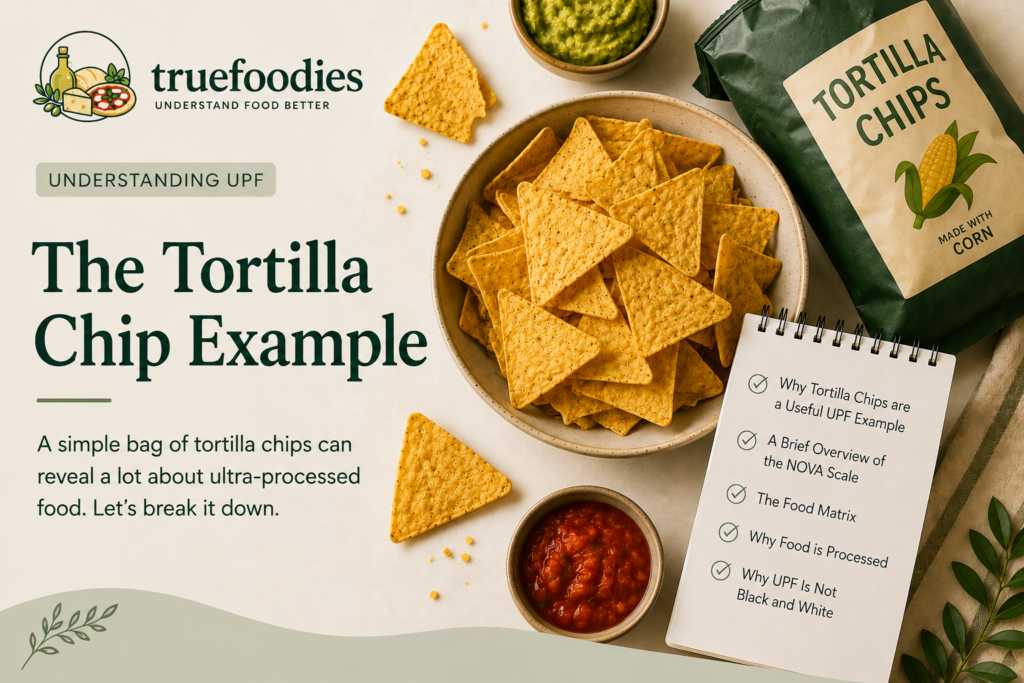
Understanding UPF Through the Tortilla Chip Example
What is Ultra Processed Food? This article is not designed to be a science lesson, nor is it designed to tell you what to eat and spoiler alert — the answer is largely inconclusive.
You have probably seen various different people giving very definitive opinions on UPF, often completely contradicting each other. Some people suggest avoiding ultra-processed foods entirely. Others suggest limiting them to around 20% of your diet. Others say the whole thing is overblown nonsense.
Confused? Probably.
So what is the answer?
Honestly, don’t sweat the small stuff. Absolutely addicted to Diet Cola? Yeah, it’s has no real benefit to you whatsoever — but you’re probably not drinking it thinking it’s a health tonic. Equally, if you cut out every heavily ultra-processed food from your diet except that, your overall diet would probably still improve massively.
If you even swapped just one UPF product from your weekly shop for something less processed, you are moving in the right direction. How far you take that is entirely your decision.
And that is partly why UPF becomes such a messy conversation online. What one person considers “obviously ultra-processed,” another person considers perfectly reasonable. Somewhere in the middle of all that confusion sits tortilla chips — which are actually one of the best examples of why UPF is far more nuanced than social media often makes it sound.
Why Tortilla Chips Are a Useful UPF Example
When many people think about ultra-processed food, they picture products that are obviously artificial like:
- fizzy drinks,
- sweets,
- instant noodles,
Tortilla chips are more interesting because they sit in a grey area. At their simplest, tortilla chips can be made from corn, oil and salt. That is not especially different from many traditional foods people have prepared for generations. But — and this is where things get interesting — not all tortilla chips are the same. Some are made with:
- flavour enhancers,
- emulsifiers,
- colourings,
- and preservatives.
They look almost identical on the shelf, but under the NOVA system they may actually belong to completely different groups. And that is exactly why tortilla chips are such a useful example when trying to understand UPF properly.
The NOVA Classification System
The NOVA system is the most commonly used method for classifying foods based on the extent and purpose of processing.
The four NOVA groups are:
- Group 1 – Unprocessed or minimally processed foods
- Group 2 – Processed culinary ingredients
- Group 3 – Processed foods
- Group 4 – Ultra-processed foods
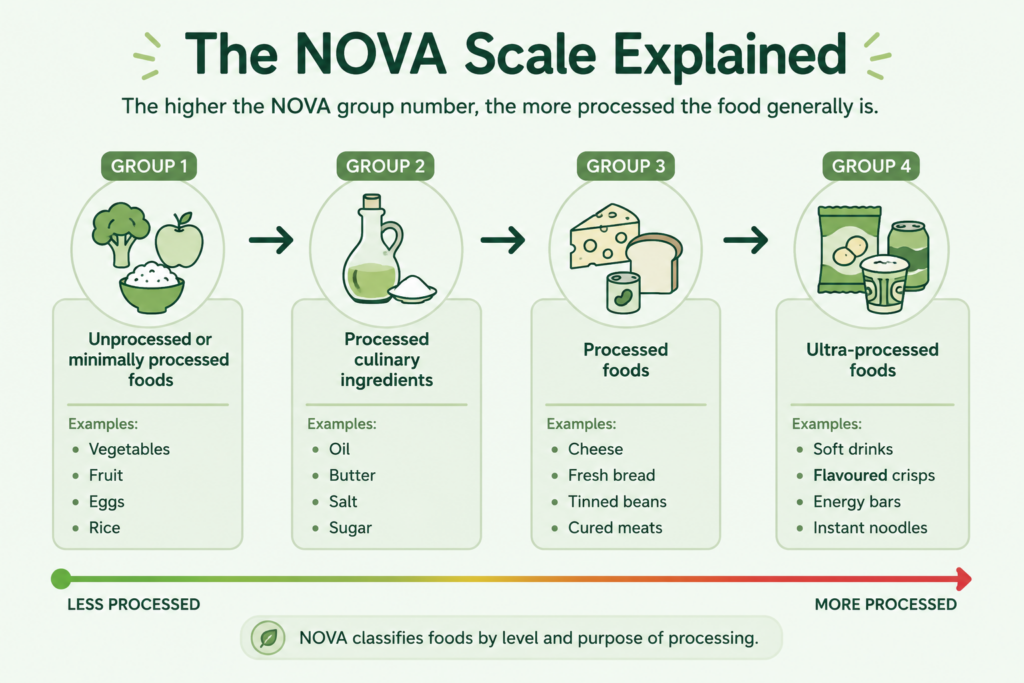
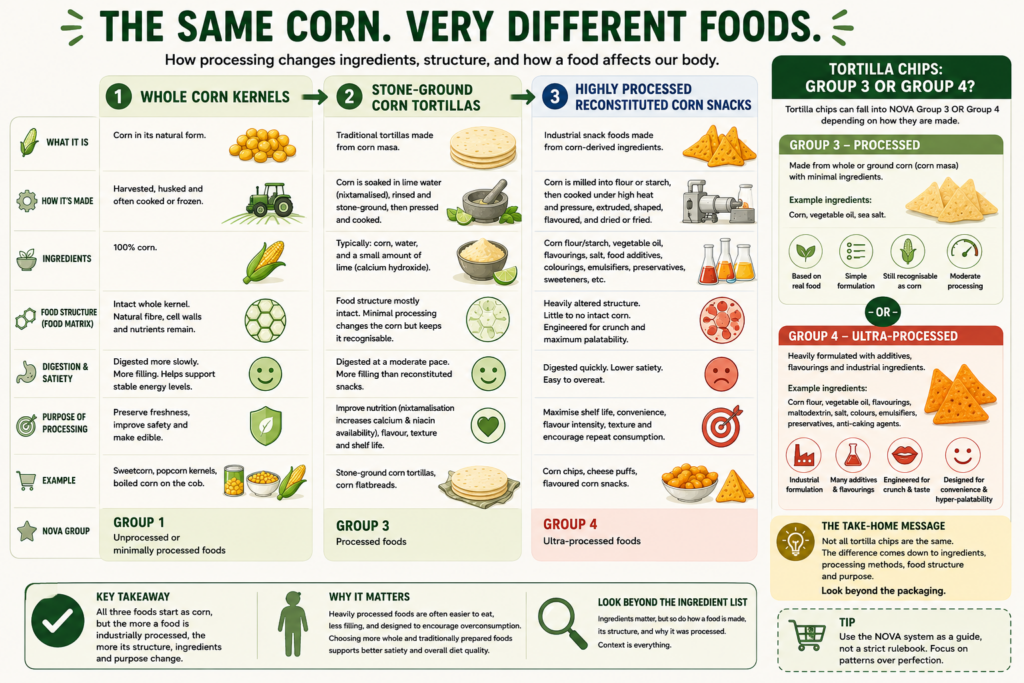
A plain tortilla chip made using just corn, oil and salt may fall into NOVA Group 3. However, a tortilla chip made with flavour enhancers, colourings, emulsifiers, preservatives and industrial additives is far more likely to fall into NOVA Group 4.
This is one of the most important lessons when learning about UPF:
Two foods can look almost identical but belong to completely different NOVA categories depending on formulation and processing.
Ingredients Matter — But Context Matters Too
One of the first things many people do when reducing UPF is start reading ingredient labels. And to be fair, that’s not necessarily a bad thing. It is probably something more people should do occasionally. But ingredient lists can also become a rabbit hole very quickly. A common misconception online is:
“If you cannot pronounce it, do not eat it.”
Realistically, things are not that simple. Some scientific-sounding ingredients are completely harmless. Others are more controversial. Some ingredients naturally occur in foods but are also produced industrially. Some are added for preservation, others for texture, flavour or shelf life.
Context matters. A tortilla chip containing corn, sunflower oil and sea salt is clearly very different from one containing maltodextrin, emulsifiers, flavour enhancers, colourings,and multiple preservatives. But the important thing is not simply “more ingredients = bad.” The better question is:
“Why are these ingredients being used?”
Are they there to preserve food, improve safety, and help basic preparation?
Or are they mainly there to: intensify flavour, improve mouthfeel, extend shelf life, and make the product hyper-palatable?
That is usually where the more interesting conversation around UPF starts.
The Food Matrix
This is the part of the conversation that people often overlook completely.
The “food matrix” basically refers to the structure of food:
- how ingredients are arranged,
- how intact the food remains,
- and how processing changes the way food behaves in the body.
This matters because two foods with similar ingredients can behave very differently depending on how heavily their structure has been altered. For example whole corn kernels, stone-ground corn tortillas and highly processed reconstituted corn snacks all originate from corn – but they are structurally very different foods.
More heavily processed foods are often easier to chew, faster to eat, less filling and easier to overconsume. This is one reason many UPFs are described as “hyper-palatable.” The issue is not always the individual ingredients alone — sometimes it is the way the food has been processed.
Food structure may matter just as much as ingredients.
The Purpose of Processing
One of the most useful questions you can ask is:
Why was the food processed in the first place?
Some processing exists primarily to preserve food, improve safety, reduce waste or making cooking easier. For example freezing vegetable, drying beans, pasteurising milk or making yoghurt. None of those things are inherently bad. Other forms of processing are more focused on maximising shelf life, increasing convenience, intensifying flavour, improving texture and encouraging repeat consumption. That does not automatically make every ultra-processed food “bad,” but it does help explain why many UPFs are designed very differently from traditional foods.
Tortilla chips once again provide a useful example. There is a large difference between a simple salted corn tortilla chip and a heavily engineered “cool ranch” chip coated in industrial flavourings. Both are technically tortilla chips, but realistically, they are very different foods.
Why UPF Is Not Black and White
One of the biggest mistakes people make when learning about UPF is assuming foods fit neatly into “healthy” or “unhealthy”. Reality is much messier. Not all ultra-processed foods are identical. Not all minimally processed foods are automatically nutritious. And anyone pretending there is a perfectly simple answer is probably oversimplifying things.
Even within the same category one tortilla chip may contain just three ingredients, while another contains twenty.
This is why understanding UPF should be about awareness, context and informed decision making. Not fear or perfectionism.
The goal of understanding UPF is not perfection — it is awareness.
Tortilla chips demonstrate that food is rarely as simple as “healthy” or “unhealthy” in some neat black-and-white way. Ingredients, processing methods, food structure, and manufacturing purpose all matter. Two foods can look almost identical and still be completely different products underneath.
The more you learn about UPF, the easier it becomes to:
- read ingredient labels,
- understand food formulation,
- and make informed choices without obsessing over every product.
Reducing UPF does not require perfection.
It simply requires curiosity, balance, and a better understanding of how modern food is made.
Leave a Reply
You must be logged in to post a comment.